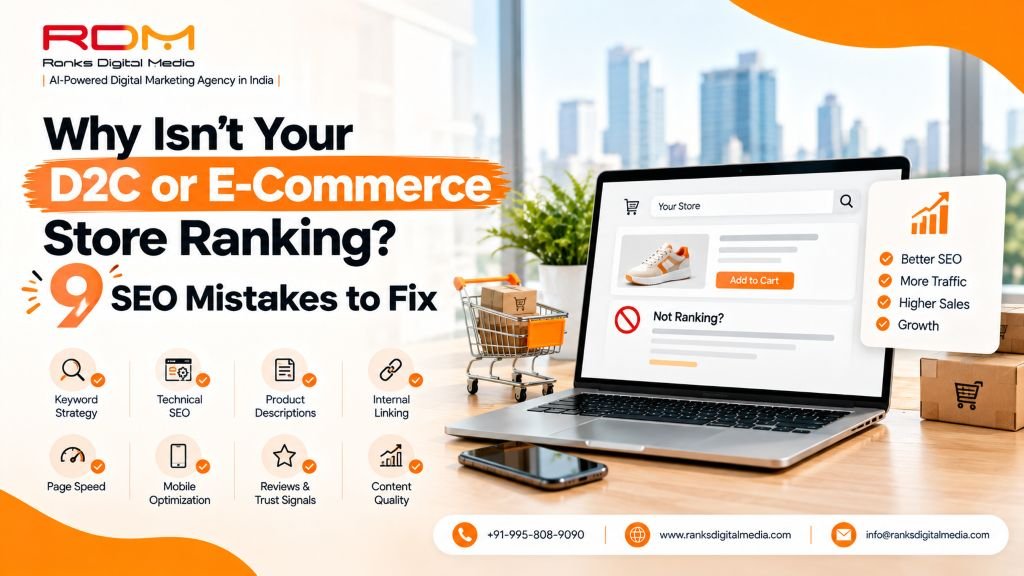
If you’ve invested in SEO for your D2C or e-commerce brand and traffic still isn’t moving, you’re not alone — and it’s rarely one dramatic failure. It’s usually a combination of smaller, fixable issues stacking up. Here are the nine most common reasons ecommerce SEO stalls for Indian D2C brands, and what an experienced ecommerce SEO company actually checks first.
The 9 SEO Mistakes Holding Your D2C Store Back
Duplicate Content From Product Variants
Color and size variants often generate near-identical product pages with only minor differences, which search engines can treat as duplicate content, diluting ranking signals across multiple thin pages instead of consolidating them onto one strong page. Proper canonical tagging or variant-parameter handling is one of the first things to audit.
Thin or Manufacturer-Copied Product Descriptions
Pasting manufacturer-supplied product descriptions across hundreds of listings — often identical to what competitors are also using — gives Google nothing unique to rank. Original, benefit-focused product copy (even a few genuinely rewritten paragraphs per product) consistently outperforms templated descriptions.
Poor Category Page Structure and Faceted Navigation
Filter combinations (size + color + price range) can generate thousands of near-duplicate, low-value URLs if faceted navigation isn’t configured correctly, wasting crawl budget and diluting authority away from the category pages that actually deserve to rank.
Slow Page Speed From Unoptimized Product Images
E-commerce sites are especially prone to slow load times from large, unoptimized product images — a critical issue since page speed is both a ranking factor and a direct driver of cart abandonment on mobile.
Missing or Incomplete Structured Data (Product Schema)
Product schema (price, availability, review ratings) enables rich snippets in search results — often the difference between a plain blue link and a listing with stars, price, and stock status. Many D2C sites either skip this entirely or implement it inconsistently across their catalog.
No Content Strategy Beyond Product Pages
Product and category pages alone rarely rank for higher-funnel, research-stage searches. Brands that pair their catalog with genuinely useful buying-guide and comparison content tend to capture significantly more organic traffic than those relying on product pages alone.
Out-of-Stock Products Left Live With No Redirect Strategy
Discontinued or out-of-stock products left as dead-end pages (or worse, deleted with no redirect) waste accumulated ranking authority and create poor user experience. A clear policy — redirect to the closest active alternative, or keep the page live with clear “notify me” messaging — preserves that SEO equity.
Ignoring Mobile Experience Specifics for Indian Shoppers
With the majority of Indian e-commerce traffic on mobile, issues like slow mobile checkout flows, intrusive pop-ups, and unoptimized mobile product galleries directly affect both rankings (via Google’s mobile-first indexing) and actual conversion rates.
No Clear Internal Linking Between Related Products and Guides
Without deliberate internal linking (related products, “customers also bought,” category-to-guide links), search engines struggle to understand which pages matter most, and authority doesn’t flow efficiently through the catalog.
Why “Fixing SEO” for D2C Brands Requires More Than Generic SEO Knowledge
D2C and e-commerce SEO sits at the intersection of three layers. A seo company in India that genuinely works with e-commerce and D2C brands should be comfortable auditing all three — not just running a generic keyword report.
A Simple First Audit You Can Run Yourself
Before hiring anyone, check these three things:
- Search
site:yourdomain.comin Google to see how many pages are actually indexed versus how many exist - Run your top 5 product pages through Google’s PageSpeed Insights for mobile
- Check Search Console’s Coverage report for “duplicate without user-selected canonical” warnings
These three checks alone surface most of the issues above.
🛒 How Ranks Digital Media Approaches E-Commerce & D2C SEO
Ranks Digital Media works with e-commerce and D2C brands across Shopify, WooCommerce, and custom platforms, auditing technical architecture, product schema, and content strategy together rather than treating them as separate problems. If your ecommerce SEO isn’t working and you’re not sure why, we offer a free technical audit covering exactly the nine issues above.
Here’s what a free ecommerce SEO audit covers:
- 🔍 Duplicate Content & Canonical Audit — Are product variants diluting your ranking signals?
- 📝 Product Description Review — Is your copy genuinely unique, or manufacturer-copied?
- 🗂️ Faceted Navigation Analysis — How many low-value URLs is your filter system generating?
- ⚡ Page Speed Assessment — Mobile load times for your top product pages
- 📊 Product Schema Check — Are you eligible for rich snippets in search results?
- 📚 Content Strategy Review — Do you have buying guides and comparison content?
- 🔗 Internal Linking Analysis — Is authority flowing efficiently through your catalog?
- 📋 Prioritized Fix Plan — What to fix first for the fastest ranking improvement
💡 Get a Free Ecommerce SEO Audit and find out exactly which of these nine issues are costing you rankings. Most D2C brands have three or more of these problems without realizing it.
Limited audit slots available for D2C and e-commerce brands
Frequently Asked Questions
Conclusion
Ecommerce SEO rarely fails dramatically. It fails quietly — one thin product description, one unconfigured canonical, one slow image at a time. Individually, each issue feels minor. Stacked together across a catalog of hundreds or thousands of products, they compound into a store that Google struggles to rank, no matter how much content or how many ads you invest in.
The good news: all nine issues are fixable, and most show measurable improvement within weeks. The better news: most of your competitors are ignoring at least half of them. Fixing your D2C store’s SEO fundamentals isn’t just about catching up — it’s a chance to pull ahead while others keep chasing content and ads without fixing the foundation underneath.
Explore our related services: