
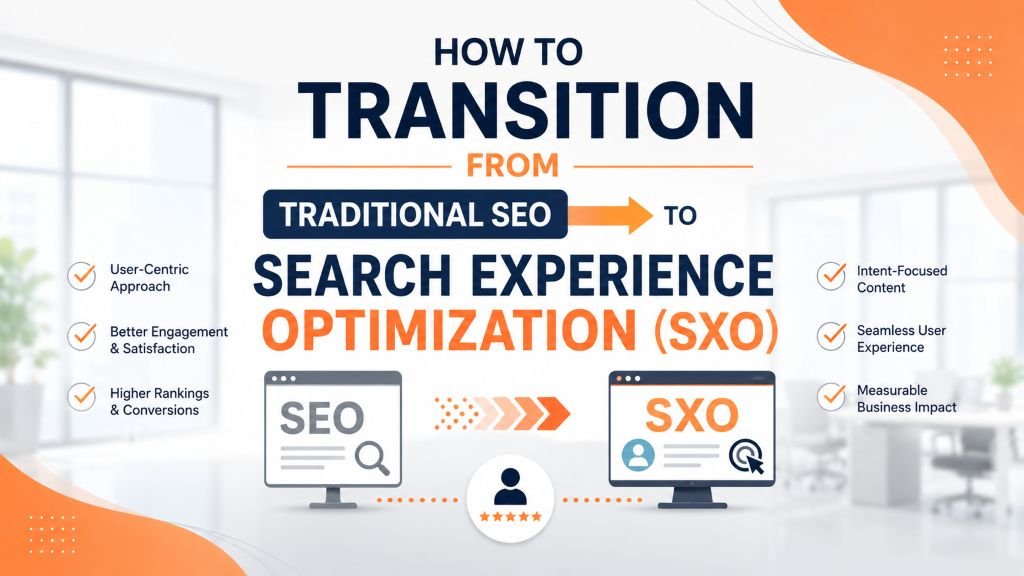
With the rise of AI Overviews and Generative Engine Optimization (GEO), "zero-click" searches are dominating top-of-funnel queries. When users do click through to a website, they have high intent and zero patience. If your site doesn't load instantly and provide exactly what they need without friction, they bounce. And today, Google treats that bounce as a critical quality failure, actively dropping your rankings.
To protect your traffic and drive actual revenue, you must transition your strategy to Search Experience Optimization (SXO). Here is exactly how to bridge the gap between traditional SEO and User Experience (UX).
What is Search Experience Optimization (SXO)?
Traditional SEO asks, "Am I visible?" SXO asks, "Am I useful, fast, and engaging?"
If an AI engine sends a high-value lead to your landing page, SXO ensures that the user's cognitive load is practically zero, guiding them effortlessly to a purchase or consultation.
SXO Strategies: How to Improve Search Experience Optimization
Transitioning to an SXO mindset requires treating your web development and marketing as a single, unified workflow. Here are the core strategies to implement.
1. Master the 2026 Core Web Vitals (Focus on INP)
Speed is no longer just a technical checkbox; it is the foundation of user trust. While traditional metrics like Largest Contentful Paint (LCP) remain important, 2026 search algorithms heavily weigh Interaction to Next Paint (INP).
The SXO Fix: INP must be under 200 milliseconds. This requires lean code. Audit your site to break up long JavaScript tasks, optimize third-party tracking scripts, and utilize aggressive server-side caching.
📊 Get a Free Technical Speed Audit
2. Design for "Mobile-Only" Usability
We have moved past "mobile-first" indexing into a mobile-only reality. Search algorithms now proxy human touch behavior to evaluate mobile interfaces.
The SXO Fix: Ensure all interactive touch targets (buttons, links) are at least 48x48 pixels with an 8px safety zone between them. Ban all intrusive overlays that block the main content upon load. If your current CMS makes this difficult, you need professional web development intervention to rebuild the mobile layout.
3. Align with Hyper-Specific Search Intent
Ranking for a keyword means nothing if the page doesn't instantly deliver what the user expects.
The SXO Fix: Place the most critical information—the direct answer to the query—"above the fold" (visible immediately without scrolling). Use clear H2 and H3 tags to build a logical knowledge tree. Provide the "Information Gain" right away, then use the rest of the page to build deep, contextual authority.
4. Integrate Conversion Rate Optimization (CRO)
An optimized search experience naturally concludes with a conversion. If users consume your content but don't take action, your SXO strategy is incomplete.
The SXO Fix: Implement sticky, context-aware CTAs. If a user is reading a technical guide on server speed, the CTA should say "Get a Free Site Speed Audit," not just "Contact Us." Eliminate "dead clicks" by ensuring every interactive element on the page actually functions as the user expects.
| Traditional SEO | Search Experience Optimization (SXO) |
|---|---|
| Focuses on rankings & clicks | Focuses on dwell time & conversions |
| Keyword density matters | Task completion matters |
| Optimizes for crawlers | Optimizes for humans & AI |
| Success = #1 position | Success = Low bounce rate + High CVR |
🚀 Upgrade Your Search Experience with Ranks Digital Media
As search algorithms become more sophisticated, isolating SEO from web development is a failing strategy. To win in 2026, you need a cohesive approach that balances technical speed, flawless mobile design, and deep search intent alignment.
The digital marketing consultants and web developers at Ranks Digital Media specialize in bridging this exact gap. We rebuild site architectures and optimize content workflows to ensure that when you earn a click, you earn a client.
🔥 What we do differently:
- 🏠 Entity Homepages that satisfy both users and AI crawlers
- ⚡ INP optimization under 200ms (not just LCP)
- 📱 Mobile-only UX audits with 48px touch targets
- 🎯 Context-aware CTAs that convert intent into action
💡 Stop losing high-intent leads to a poor mobile experience. Book a strategy session today.