
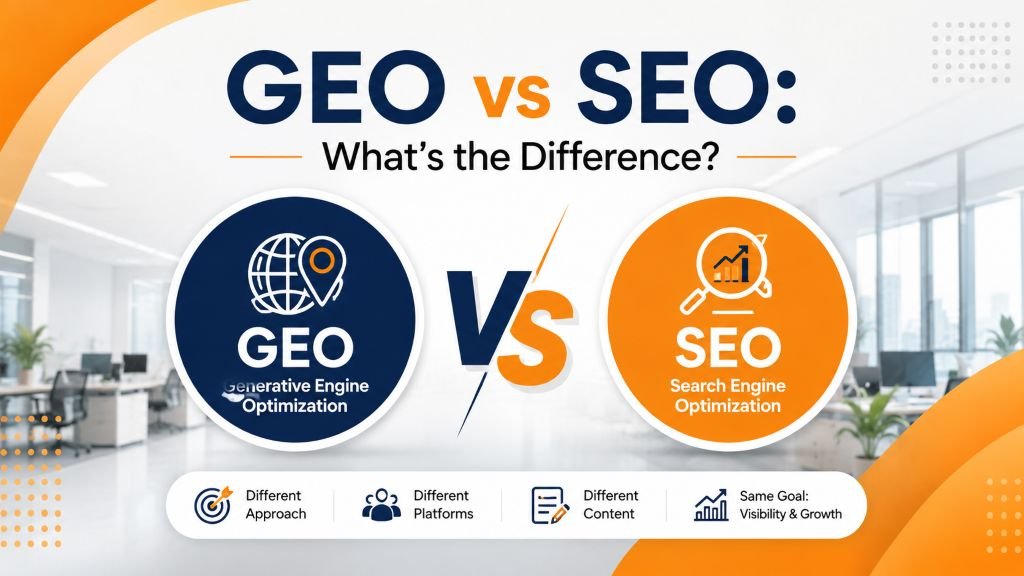
GEO vs SEO: What's the Difference? AI Search
The search landscape is evolving faster than ever. For years, businesses focused on Search Engine Optimization (SEO) to improve their visibility on Google and other traditional search engines. While SEO continues to play a vital role in digital marketing, the rapid adoption of artificial intelligence has introduced a new concept known as Generative Engine Optimization (GEO).
Today, millions of users are searching for answers through AI-powered platforms such as Google AI Overviews, ChatGPT, Gemini, Microsoft Copilot, and Perplexity AI. Instead of displaying a list of blue links, these platforms generate direct answers by analyzing information from multiple trusted sources. This shift is changing how businesses create content and how potential customers discover brands online.
As a result, businesses must optimize not only for search engines but also for AI-driven search experiences. This is where GEO Services, AI Search Optimization, and LLM Optimization become increasingly important.
What Is Search Engine Optimization (SEO)?
Modern SEO is much more than adding keywords to a webpage. Search engines evaluate hundreds of ranking signals, including:
- High-quality, original content
- Website speed and Core Web Vitals
- Mobile responsiveness
- Internal linking structure
- Backlink quality
- Search intent alignment
- User experience
- Website security
- Structured data implementation
An effective SEO strategy helps businesses build long-term visibility, generate qualified leads, and improve online credibility.
Why SEO Still Matters
Despite the rise of AI-powered search, traditional search engines remain a primary source of website traffic. Every day, billions of searches are performed on Google for products, services, local businesses, and informational queries.
Businesses that invest in professional SEO can benefit from:
- Sustainable organic traffic
- Increased brand visibility
- Better conversion rates
- Higher trust among users
- Reduced dependence on paid advertising
- Long-term return on investment
What Is Generative Engine Optimization (GEO)?
Unlike traditional search engines, AI search platforms do not simply rank web pages. They analyze trusted information, understand relationships between topics, and generate conversational responses that answer user questions.
For example, instead of showing ten website links for the query:
"What is the best SEO strategy for a local business?"
an AI-powered search engine may provide a detailed answer that summarizes information from multiple authoritative websites.
Businesses that want to appear within these AI-generated responses must optimize their content differently than they would for traditional search engines.
How GEO Works
Generative Engine Optimization focuses on making content easier for AI systems to interpret, summarize, and reference.
This involves creating content that is:
- Factually accurate
- Well-structured
- Topically comprehensive
- Easy to understand
- Supported by clear headings
- Rich in contextual information
- Organized around entities rather than keywords alone
Instead of asking, "How do I rank #1 on Google?" businesses should also ask:
"How can my content become a trusted source that AI systems choose to reference?"
What Is AI Search Optimization?
AI Search Optimization is a broader strategy that helps businesses improve their visibility across AI-powered search experiences.
It combines traditional SEO best practices with techniques specifically designed for generative AI systems.
AI Search Optimization includes:
- Creating authoritative content
- Answering user questions clearly
- Building topical authority
- Using structured data
- Improving entity recognition
- Publishing original research and insights
- Demonstrating expertise and trustworthiness
- Maintaining accurate business information
Rather than replacing SEO, AI Search Optimization expands it to include platforms that generate answers instead of simply listing web pages.
What Is LLM Optimization?
Large Language Models (LLMs) power many of today's AI search tools, including ChatGPT, Gemini, Claude, Microsoft Copilot, and others.
LLM Optimization focuses on making website content easier for these models to understand, summarize, and recommend.
While SEO optimizes for search engine algorithms, LLM Optimization optimizes for AI comprehension.
Important elements of LLM Optimization include:
- Clear content structure
- Logical heading hierarchy
- Natural language writing
- Comprehensive topic coverage
- Accurate factual information
- Strong contextual relevance
- Consistent brand authority
- High-quality supporting resources
GEO vs SEO: What's the Difference?
Although SEO and GEO share the same objective of improving online visibility, they target different types of search experiences.
| Feature | SEO | GEO |
|---|---|---|
| Primary Goal | Rank in traditional search engines | Appear in AI-generated answers |
| Platforms | Google, Bing | ChatGPT, Gemini, Google AI Overviews, Copilot, Perplexity |
| Ranking Method | Search engine algorithms | Large Language Models and AI systems |
| Focus | Keywords, backlinks, technical SEO | Context, entities, authority, structured knowledge |
| User Experience | Search result listings | Conversational AI responses |
| Optimization Strategy | Search Engine Optimization | Generative Engine Optimization |
Why GEO Matters in 2026
AI-powered search is transforming user behavior. Instead of clicking multiple search results, users increasingly expect immediate, conversational answers.
This shift creates new opportunities for businesses that produce trustworthy, high-quality content.
Organizations investing in Generative Engine Optimization today can gain several advantages:
- Greater visibility in AI-generated search results
- Increased brand recognition
- Higher authority within their industry
- Better user engagement
- Stronger long-term content performance
- Future-ready digital marketing strategy
How GEO Services Help Businesses Grow Online
As AI-powered search platforms become more popular, businesses need to ensure their content is not only discoverable by traditional search engines but also understandable by artificial intelligence. This is where GEO Services play a crucial role.
Generative Engine Optimization focuses on creating content that AI systems can confidently interpret, summarize, and reference. Rather than optimizing solely for keyword rankings, GEO helps businesses build topical authority, improve content quality, and increase their chances of being included in AI-generated answers.
For example, when a potential customer asks an AI assistant for the "best digital marketing strategy for a small business," the platform may recommend information from trusted websites that demonstrate expertise and provide comprehensive answers. Businesses using GEO strategies are more likely to become part of those recommendations.
Core Components of Effective GEO Services
Successful Generative Engine Optimization requires a structured approach. The following elements form the foundation of an effective GEO strategy.
Build Topical Authority
Publishing one article about a topic is rarely enough. AI models prefer websites that cover a subject comprehensively through multiple interconnected resources.
For example, if your business offers SEO services, your website should include content covering:
- SEO Services
- Local SEO
- Technical SEO
- Ecommerce SEO
- SEO Audits
- Content Marketing
- AI SEO
- GEO
- Google AI Overviews
- LLM Optimization
Creating topic clusters helps AI systems understand your expertise while strengthening your authority in traditional search results.
Write for Questions, Not Just Keywords
Traditional SEO often focuses on optimizing for specific keywords.
GEO goes a step further by answering complete user questions.
Instead of targeting only:
- GEO Services
Also answer questions like:
- What is Generative Engine Optimization?
- How does GEO differ from SEO?
- Why is GEO important for AI search?
- Can GEO improve ChatGPT visibility?
- What is AI Search Optimization?
- How do large language models evaluate content?
This conversational structure aligns with how users interact with AI assistants.
Improve Content Depth
AI systems generally prefer content that explains topics thoroughly instead of providing short, surface-level answers.
Comprehensive articles often include:
- Definitions
- Examples
- Comparisons
- Benefits
- Challenges
- Best practices
- Frequently asked questions
- Real-world applications
Adding meaningful depth increases the likelihood that AI systems recognize your content as authoritative.
Focus on Entities Instead of Keyword Stuffing
Search engines and AI platforms increasingly understand relationships between people, businesses, locations, products, and concepts.
Rather than repeating the phrase "Generative Engine Optimization" dozens of times, naturally include related entities such as:
- Artificial Intelligence
- Large Language Models
- Google AI Overviews
- ChatGPT
- Gemini
- Microsoft Copilot
- Perplexity AI
- Semantic Search
- Knowledge Graph
- Search Intent
AI Search Optimization Best Practices
AI Search Optimization combines technical excellence with high-quality content.
Businesses preparing for AI-driven search should focus on several important areas.
Create Clear Content Structures
Well-organized articles are easier for AI systems to analyze.
Use:
- Descriptive headings
- Logical content hierarchy
- Bullet points
- Numbered lists
- Comparison tables
- Short summaries after complex topics
Structured content improves readability for both users and AI.
Demonstrate Real Expertise
AI platforms increasingly prioritize trustworthy information.
Instead of publishing generic articles, include:
- Original insights
- Industry experience
- Practical examples
- Case studies
- Actionable recommendations
This strengthens your website's authority while improving user trust.
Keep Content Updated
AI systems prefer current and relevant information.
Review important articles regularly by:
- Updating statistics
- Revising screenshots
- Adding new examples
- Covering recent algorithm updates
- Expanding frequently asked questions
Fresh content signals ongoing expertise.
Optimize Technical Performance
Although GEO focuses heavily on content quality, technical SEO remains essential.
Ensure your website provides:
- Fast loading speeds
- Mobile responsiveness
- Secure HTTPS connections
- Clean site architecture
- Proper schema markup
- Optimized Core Web Vitals
Technical excellence supports both SEO and GEO performance.
LLM Optimization: Preparing Content for AI Models
Large Language Models process information differently from traditional search engines.
Rather than matching keywords, they analyze meaning, context, and relationships between concepts.
Successful LLM Optimization focuses on making information easier to understand.
Characteristics of LLM-Friendly Content
Well-optimized content typically includes:
- Simple language
- Clear explanations
- Logical flow
- Consistent terminology
- Comprehensive topic coverage
- Accurate facts
- Strong internal linking
This approach helps AI systems interpret your content with greater confidence.
Internal Linking Supports AI Understanding
Internal links help both users and AI discover related content across your website.
For example, if readers are learning about GEO, they may also benefit from related resources such as:
A strong internal linking strategy strengthens topical authority while improving navigation.
Common GEO Mistakes Businesses Should Avoid
Many organizations are beginning to optimize for AI search, but some common mistakes reduce effectiveness.
Publishing Thin Content
Short articles with limited information rarely establish authority.
Instead, create comprehensive resources that fully answer user questions.
Relying on AI Without Human Review
AI-generated drafts should always be reviewed by subject matter experts.
Original insights, practical experience, and editorial oversight improve accuracy and trustworthiness.
Ignoring User Intent
Every article should solve a real problem.
Ask yourself:
"What information does the reader actually need?"
Content that prioritizes user value performs better across both traditional search and AI search.
Overusing Keywords
Keyword stuffing reduces readability and may weaken content quality.
Use primary keywords naturally while incorporating related terminology and entities throughout the article.
How SEO and GEO Work Together
One of the biggest misconceptions is that businesses must choose between SEO and GEO.
In reality, they complement one another.
- SEO helps websites become visible within traditional search results.
- GEO helps businesses become visible within AI-generated responses.
The strongest digital marketing strategies combine both approaches.
For example:
- SEO improves rankings on Google Search.
- GEO improves visibility in ChatGPT, Gemini, Copilot, and Google AI Overviews.
- Together, they increase overall online discoverability.
The Future of GEO, SEO, and AI-Powered Search
The way people discover information online is evolving rapidly. Traditional search engines remain an essential source of website traffic, but AI-powered search experiences are becoming an increasingly important part of the customer journey. Users now expect immediate, conversational, and accurate answers instead of simply scrolling through pages of search results.
As AI models continue improving, businesses that publish helpful, trustworthy, and well-structured content will have greater opportunities to appear in AI-generated responses. This shift does not mean SEO is becoming obsolete. Instead, SEO is expanding to include strategies that help AI systems understand, evaluate, and reference high-quality content.
Forward-thinking businesses should view Generative Engine Optimization, AI Search Optimization, and LLM Optimization as natural extensions of a modern SEO strategy. By combining technical excellence, topical authority, and user-focused content, organizations can improve visibility across both traditional search engines and AI-driven platforms.
GEO Implementation Checklist
If you're planning to optimize your website for AI-powered search, use the following checklist as a starting point.
Content Strategy
- Publish comprehensive, topic-focused articles
- Build content clusters around your core services
- Answer common customer questions
- Include original insights and practical examples
- Update content regularly to maintain relevance
Technical Optimization
- Improve page speed
- Optimize Core Web Vitals
- Ensure mobile responsiveness
- Use HTTPS across the website
- Implement structured data where appropriate
- Maintain a logical internal linking structure
AI Search Optimization
- Write naturally using conversational language
- Focus on entities rather than excessive keyword repetition
- Create content that demonstrates expertise and trustworthiness
- Organize content with clear headings and logical flow
- Include comparison tables, FAQs, and summaries where relevant
🚀 Why Choose Ranks Digital Media for GEO & SEO Services
At Ranks Digital Media, we help businesses build digital strategies that are designed not only for today's search engines but also for tomorrow's AI-powered search experiences.
Our approach combines traditional SEO excellence with cutting-edge GEO strategies to ensure your content is discoverable across all platforms—from Google Search to ChatGPT, Gemini, and Google AI Overviews.
We help you:
- 📊 Build Topical Authority – Establish your brand as an expert in your industry
- 🔧 Optimize for AI Search – Get cited by ChatGPT, Gemini, and Copilot
- 📈 Improve Traditional SEO – Rank higher on Google and Bing
- 🤖 Implement LLM Optimization – Make your content AI-friendly
- 📍 Enhance Local Visibility – Dominate local search results
- 📝 Create High-Quality Content – Authoritative content that users and AI trust
- 🔗 Build Strong Internal Linking – Strengthen your content ecosystem
- 📊 Track Performance – Transparent reporting across all channels
From technical SEO and content marketing to AI-ready optimization strategies, our goal is to help businesses build sustainable online growth through ethical, data-driven digital marketing.
💡 Ready to future-proof your digital presence? Let's build a unified SEO + GEO strategy that delivers results.
Limited slots available for businesses ready to adapt to AI search
Frequently Asked Questions
Final Thoughts
Search is entering a new era driven by artificial intelligence, conversational interfaces, and large language models. While traditional Search Engine Optimization (SEO) continues to be the foundation of organic visibility, businesses that also embrace Generative Engine Optimization (GEO) will be better positioned to succeed as AI-powered search evolves.
Instead of treating SEO and GEO as competing strategies, businesses should integrate them into a unified digital marketing approach. Strong technical performance, authoritative content, semantic relevance, and exceptional user experience remain the common factors that influence both traditional search rankings and AI-generated recommendations.
Whether you're optimizing a local business website, an ecommerce platform, or an enterprise digital presence, combining SEO, GEO Services, AI Search Optimization, and LLM Optimization will help future-proof your online visibility.
To learn more about our services, explore: