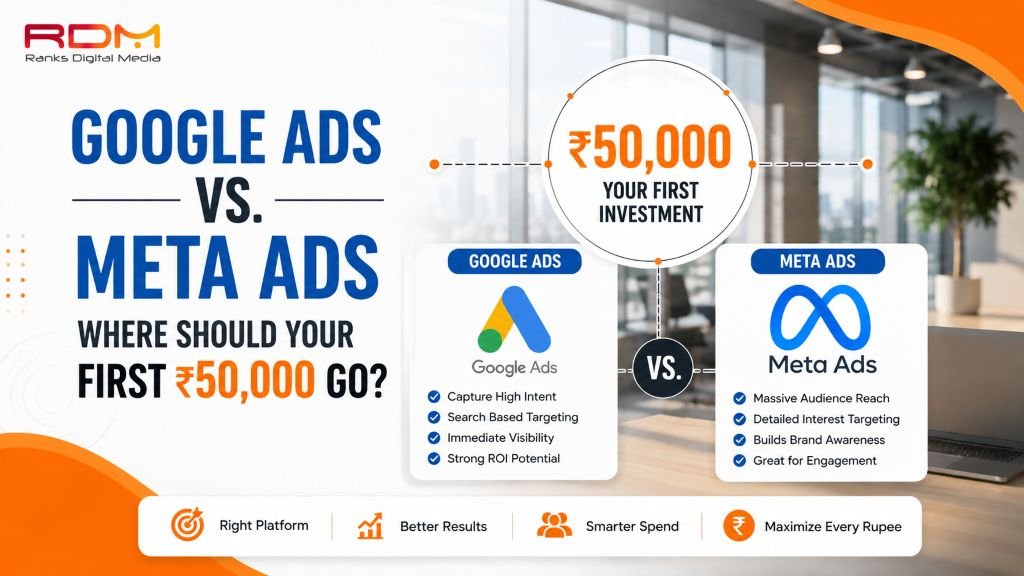
This is one of the most common questions from business owners with a limited first ad budget, and the honest answer depends entirely on what you’re selling and who’s buying — not which platform is “better” in general.
The Core Difference That Actually Matters
People already searching for what you offer, right now, with intent to buy or compare.
Reaching people who aren’t actively searching, but match your ideal customer profile based on interests and behavior.
If your product or service has clear, existing search demand — people actively typing “SEO agency near me” or “buy running shoes online” — Google Ads typically delivers faster, more predictable conversions, since you’re reaching people already close to a decision.
Best fit for:
- Service businesses with clear local demand
- Ecommerce products people actively search for by name or category
- Any business where customers know they have the need before they start looking
If your product benefits from visual discovery, or serves a need people don’t yet realize they have, Meta Ads’ interest and behavior-based targeting can outperform search — since there may not be meaningful search volume for what you’re offering yet.
Best fit for:
- Visually-driven products (fashion, home goods, food)
- New or novel products without established search demand
- Businesses building brand awareness alongside direct response
Head-to-Head: Google Ads vs. Meta Ads
| Factor | Google Ads | Meta Ads |
|---|---|---|
| Demand Type | 🔍 Captures existing search intent | 📱 Creates interest through targeting |
| Time to Conversion | ✅ Faster — intent is immediate | ⚠️ Slower — requires nurturing |
| Best for Unknown Products | ⚠️ Weak — no search volume yet | ✅ Strong — builds awareness from scratch |
| Visual Storytelling | ⚠️ Limited — text and shopping ads | ✅ Powerful — image and video native |
| Local Service Businesses | ✅ Excellent — local search intent | ⚠️ Moderate — local targeting available |
| Learning Curve | ⚠️ Steeper — keyword and bid complexity | ⚠️ Steeper — creative testing demands |
A Realistic Way to Split ₹50,000 If You’re Unsure
Primary Platform
Secondary Test
Rather than betting everything on one platform, a common, lower-risk approach is testing both at smaller scale first: roughly 60% toward whichever platform matches your core demand type, and 40% toward the other — specifically to gather real data on which actually converts better for your specific offer.
Let the data from the first 2-3 weeks guide where the next round of budget goes — don’t guess indefinitely.
📊 The Metric That Actually Matters
Don’t judge either platform purely on cost-per-click or reach. Track cost-per-lead and, ideally, cost-per-sale — a more expensive click that converts is worth more than a cheap click that doesn’t.
💰 Want Help Deciding Where Your Budget Should Go?
At Ranks Digital Media, we help Delhi businesses allocate their first ad budget — and every budget after — based on data, not platform bias. We manage campaigns on both Google Ads and Meta Ads, so our recommendation is always based on what works for your specific business.
Here’s what a free consultation covers:
- 🔍 Demand Assessment — Is there enough search volume for Google Ads to work, or should you start with Meta?
- 📊 Budget Allocation Strategy — Exactly how to split your first ₹50,000 (or whatever your budget is)
- 🎯 Conversion Tracking Setup — Making sure you can actually measure cost-per-lead and cost-per-sale
- 📈 Testing Timeline — How long to run before making allocation decisions
- 🔄 Scale Plan — What to do with the next budget once you have data
See our PPC services, performance marketing services, or Facebook Ads services for more detail.
💡 Get a free consultation and we’ll help you figure out the right starting allocation for your specific business and goals. No platform bias — just honest, data-driven advice.
Limited slots available — get your budget allocation strategy before you spend another rupee
Frequently Asked Questions
Conclusion
The Google Ads vs. Meta Ads debate has a simple answer that most “platform comparison” articles miss: it depends entirely on whether demand for your product already exists in search, or needs to be created through discovery. Neither platform is universally better — but for your specific business and your specific ₹50,000, one is almost certainly the higher-ROI starting point.
If customers are searching for what you sell, start with Google. If they need to discover it, start with Meta. If you’re genuinely unsure, split-test and let the data — specifically cost-per-lead, not cost-per-click — make the decision for you.
Explore our related services: